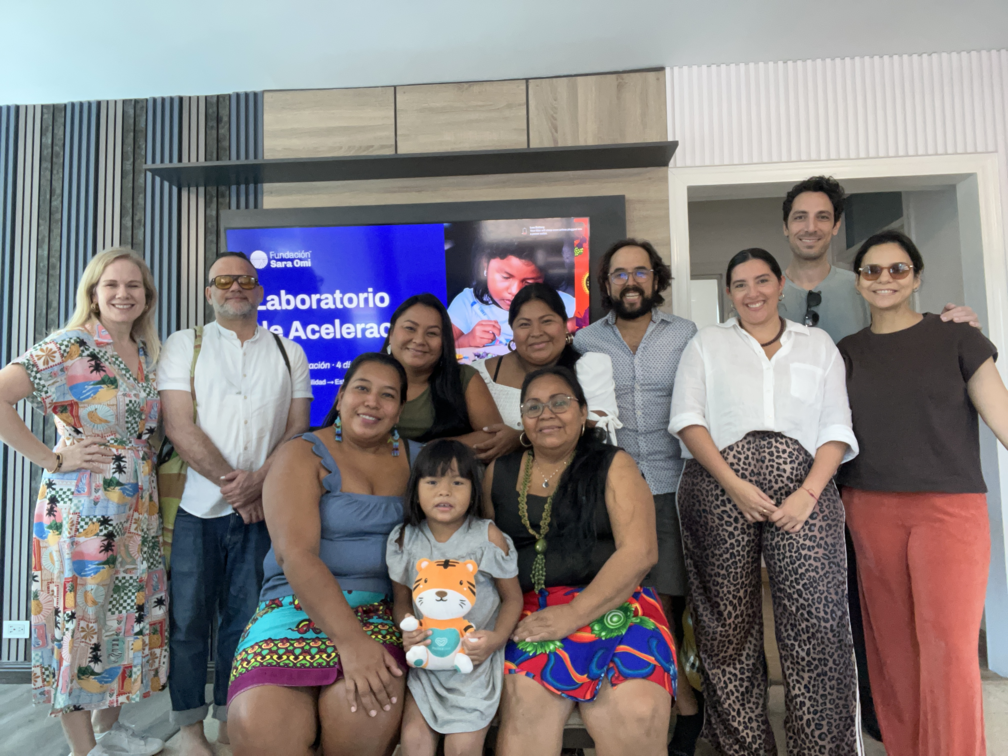
At the most recent Kaimocara circle meeting, the Sara Omi Foundation team reviewed progress on its three pillars
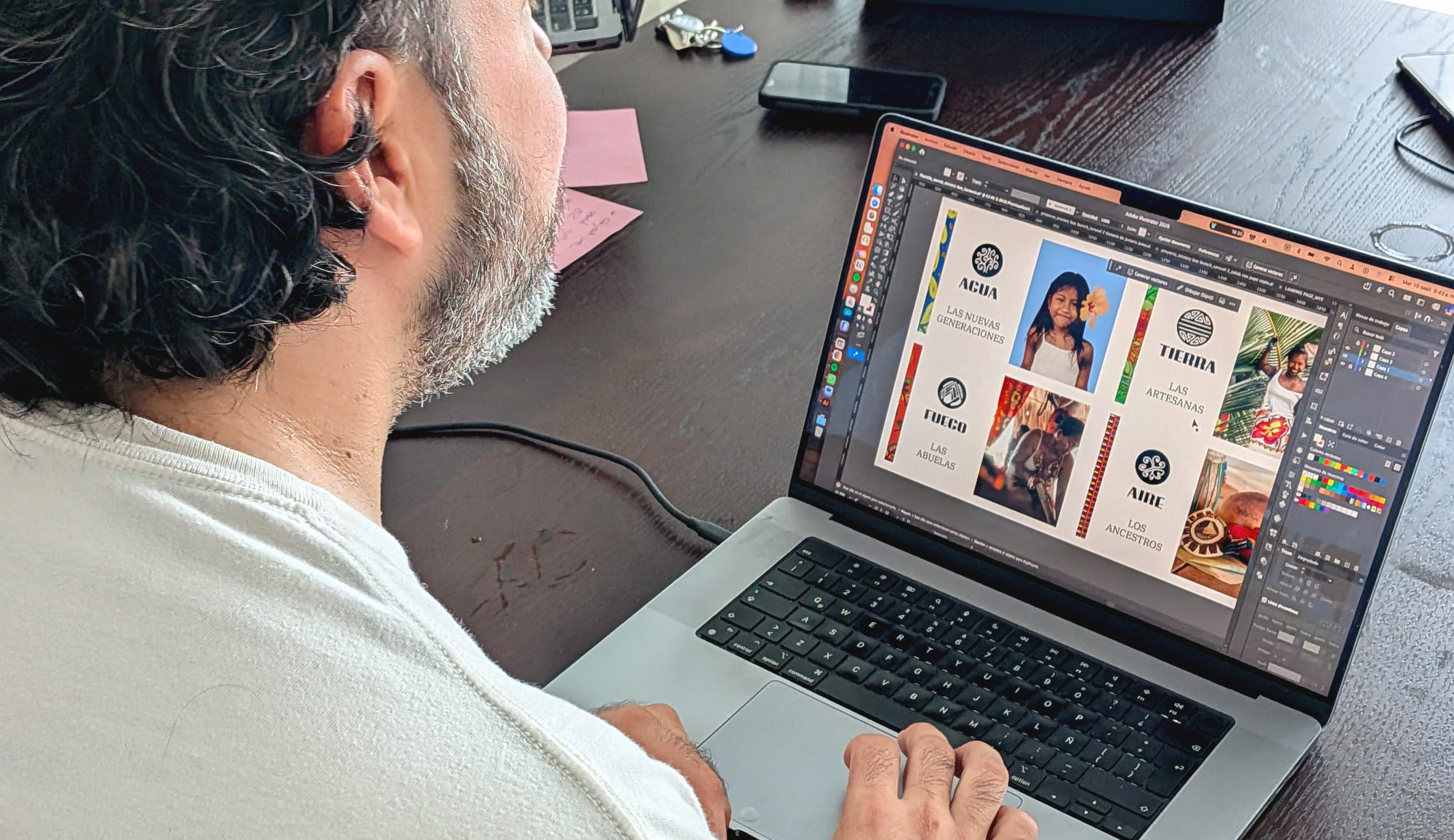
Every so often, our team sits in a circle — some in Panama, some in Ipetí, some at a distance — to do what Emberá women have done for generations: review the weave, thread by thread, and decide together what the next stitch will be.
This week that circle, which we call Kaimocara, gave us news we want to share with you. Because a foundation that works with the community — not for the community — also shares its process with the wider community that walks alongside it: you.
Here's what's taking shape.
Jumara Juwa, the commercial brand born from the art of the Amarí artisan women, is about to take its first public step: the Mystery Box, a limited edition of boxes carrying far more than crafts inside.
Each box is connected to one of the four elements of the Emberá worldview — Water, Earth, Fire, and Air — and to a generation of women. It isn't pretty packaging with a product inside. It's an invitation to get to know a culture through the hands that carry it.
Over the next 20 days, we'll tell this story on social media, in small doses:
Most importantly: Sara Omi reviewed every piece of content and validated it as authentic and representative. Nothing goes out into the world without first passing through the hands and eyes of the women whose story it tells. That's how we understand narrative sovereignty: we don't talk about them, we talk with them.
If you want to be among the first to know about the Mystery Box, we'll soon be opening a waitlist. There are only a few boxes. Each one carries a name, an element, and a story.
For months we planned to make a documentary about the foundation's work. And in this week's circle we confirmed something we'd been sensing: the story isn't told at the end — it's woven as it happens.
That's why our narrative is changing shape. Instead of a traditional documentary, we're creating a living learning curriculum: a digital platform and a social media series where the first module is literally called “How to Work with Our Communities.”
Who is it for? For funders, governments, allies, and any organization that wants to collaborate with indigenous peoples without repeating the usual mistakes: arriving with prefabricated solutions, talking without listening, measuring success by rules that aren't theirs.
This curriculum will also include something we consider essential: real data, told with dignity. Video profiles of each artisan woman documenting her starting point — her income, her context, her goals — so that impact isn't just an emotional story, but something that can be seen, measured, and verified. When an artisan's monthly income grows steadily, that number tells a story of sovereignty that no abstract statistic ever could.
The process is the documentary. The documentary is the curriculum. And the curriculum, we hope, will be a door for many other communities.
While the brand and the narrative take shape, the infrastructure follows its own rhythm — slower, more stubborn, just as important.
Water: the main filtration system for the Amarí house has already been acquired. The next step is a community-level assessment, and here's something we want to get right: coordination will happen directly between the specialized supplier and the community's rural water board. The community decides on its own water. We accompany.
Sun: an opportunity came up to get additional solar panels for the families of Ipetí. But what excites us most isn't the panels themselves — it's that the project includes training community technicians who can maintain the systems over time. Because a donated panel without local knowledge is just an object. A panel in the hands of a community that knows how to care for it is energy sovereignty.
In our circle we also talked about what's hard: syncing people, processes, and goals when the team is spread across cities, communities, and time zones. The need to see each other in person more. The pace of work when everything matters and everything is urgent.
We don't hide it, because part of our commitment is showing the whole weave — knots included. One of the proposals that came out of the circle was to create monthly in-person gatherings to strengthen ties with the community. Because screens connect, but the circle truly closes face to face.
And there's a date already starting to shine on the horizon: our official launch event will be in December. We're choosing to give this moment the time it deserves, so that when we gather to celebrate, every thread is in its place.
If you've made it this far, you're already part of this in some way. Reading, sharing, asking questions, introducing us to someone who should know us — all of that is weaving.
We're not going to ask you to "donate now" with a red button. We're going to invite you to something slower and deeper: being a co-creator of this movement.
Maybe you have a space, some knowledge, a contact, a question that helps us think better. Maybe you just want to follow closely what the women of Amaríe are achieving and tell others about it at your own table.
All of these ways of showing up count. Because this weave isn't finished by a single hand.
Write to us, follow us, walk with us. The weave has just begun, and there's room for your thread.
saraomi.org
The Sara Omi Foundation is a nonprofit organization in the process of incorporating as a 501(c)(3), dedicated to improving the quality of life of Panama's indigenous Emberá women through economic sovereignty, cultural narrative, and community development.
We're sharing how we made it for the benefit of our whole community of allies.
Get news, updates on our programs, and real ways to support indigenous women's leadership. Leave us your email and become part of this growing community.
%20(1).jpg)
