Diverse Film & Art Festival 2026
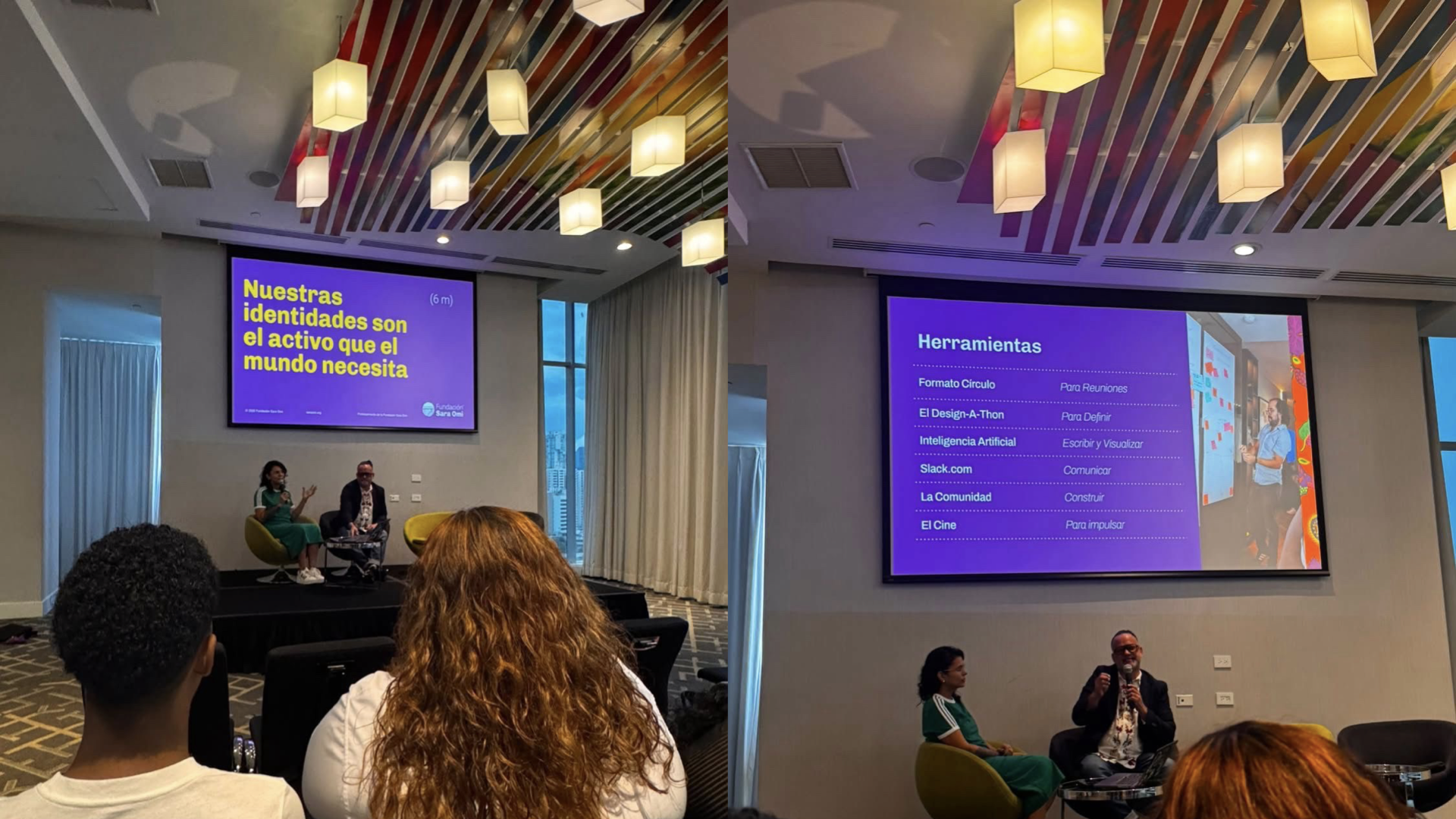
On Saturday, June 20, 2026, the Sara Omi Foundation was invited to present at the Diverse Film & Art Festival — one of the most important cultural events of Pride Week in Panama City. The setting: the W Hotel Panama. The audience: filmmakers, artists, activists, and creators from across the region.
The talk was called “Collective Construction: Tools and Reflections.”
It was presented by María Isabel Martínez, the Foundation's Director of Communications and a filmmaker, and José Caballer, the Foundation's Launch Director and a systems designer. In 25 minutes, they shared how a pre-launch foundation is using film, design, and artificial intelligence to make visible what the system has kept invisible: the identity of a women-led indigenous Emberá community.
Here's what they shared.
The Sara Omi Foundation exists because there is a huge gap between the value indigenous communities hold and the visibility the world gives them.
Our co-founder, Sara Omi Casama, is the first Emberá woman to become a lawyer in Panama. Forbes recognized her in 2026 as one of the 50 Most Powerful Women in Central America. Her story is not the exception — it's proof that the talent was always there. What was missing was the platform.
Our vision: A future where indigenous women lead thriving communities, with pride, prosperity, and economic sovereignty.
Our mission: Empower indigenous women through access to markets, story co-creation, and community development.
This isn't rhetoric. It's a work plan.
Before talking about solutions, we need to name the problem honestly.
1. Economic Opportunities Emberá artisans produce pieces of extraordinary value. But without access to markets, technology, or e-commerce, that chain breaks. The product exists. The channel doesn't.
2. Erosion of Identity The Latin American system rewards assimilation. To get ahead in society, indigenous communities are expected to abandon who they are. Identity becomes a burden — when in reality it's the most valuable asset they have.
3. Lack of Basic Infrastructure Clean water. Internet. Spaces to create and collaborate. Without that, nothing else is possible.
These three challenges aren't independent. They feed into each other. And all three have to be solved at the same time.
Here's the heart of it all.
Indigenous communities aren't invisible because they lack value. They're invisible because they haven't had spaces or platforms to show themselves. To name their reality. To say who they are.
They have been there. With centuries of ancestral wisdom. With systems of knowledge that Western civilization needs and doesn't have. With a matriarchal identity that is a model, not a relic.
The system has excluded them not for what they are, but for what they lack: visibility, connectivity, access.
So the right question isn't: how do we help them? The right question is: how do we give them the means to show themselves?
The Sara Omi Foundation's answer is clear: everything starts with identity.
The Foundation operates with three pillars that aren't separate — they're an interconnected cycle.
Accelerate Indigenous Brands → Economic Sovereignty We bring Emberá women's crafts and products to real markets, with a brand, a story, and e-commerce. Because without income of their own, everything else is dependency.
Communicate and Narrate Culture → Identity and Voice We produce audiovisual content that tells the story from the inside — not from the outside. It's not us speaking about them. It's us creating the space for them to speak.
Develop the Community → Basic Infrastructure Clean water in Ipetí. Internet. Computers. Physical spaces to create. Without this, the other two pillars have nowhere to land.
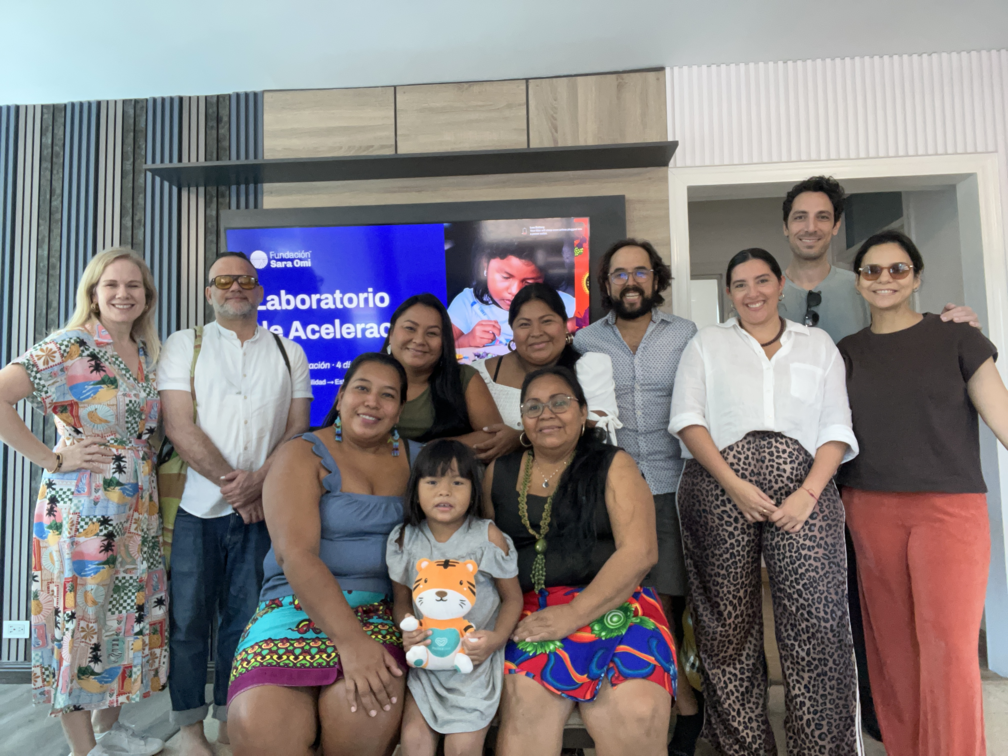
In the Design-A-Thon that brought allies, strategists, creatives, lawyers, and Emberá women together at the same table, something emerged that we call El Meollo (The Core) — the essence of who we are.
It's not a slogan. It's an internal compass.
The Sara Omi Foundation provides visibility and growth in a co-creative way, rooted in a culture of matriarchal ancestral wisdom and an inspiring voice. Helping us stay resilient and inspiring a deep pride that builds commitment to our identity and our territories among indigenous youth.
That last line says it all. Sara Omi was the first. Not to stay up there alone — but to open the door. To be the beacon for the path ahead.
We're a team of creatives, not bureaucrats. We use the tools we know and adapt them to the context.
This is the part that hit the audience hardest.
María Isabel Martínez put it bluntly:
The world is in an information war. It's not a metaphor. It's literal. Corporations, governments, social movements — they're all fighting over the same ground: the narrative people consume and believe.
And the most powerful weapon that exists for that war is the audiovisual.
Not the PDF. Not the report. Not the press release.
The video. The image. Emotion conveyed in motion.
So when a foundation says “we don't have a budget for content production” — it's saying it doesn't have a budget to exist in the reality that matters.
Film isn't an expense. It's strategic infrastructure, an investment.
For the Sara Omi Foundation, filming in Ipetí isn't about creating promotional content. It's about writing reality. It's about taking control of the story of a community that has been portrayed by others — or not portrayed at all.
To close the presentation, the team shared four direct lessons from the Foundation's collective construction process:
The Sara Omi Foundation is in active pre-launch. In the coming months:
If you want to be part of this — as an ally, donor, creative collaborator, or simply a witness to this process — the door is open.
saraomi.org
The Sara Omi Foundation is a nonprofit organization in the process of incorporating as a 501(c)(3), dedicated to improving the quality of life of Panama's indigenous Emberá women through economic sovereignty, cultural narrative, and community development.
We're sharing how we made it for the benefit of our whole community of allies.
Note: The recording was transcribed to text using Cockatoo.com
Each of these tools — Claude, Cockatoo, Loom, Webflow — has a monthly subscription cost.
Get news, updates on our programs, and real ways to support indigenous women's leadership. Leave us your email and become part of this growing community.
%20(1).jpg)
